On March 22nd 1954, thousands of students from different schools arrived at the brand-new facilities of the Ciudad Universitaria [CU] in the southwest of Mexico City to attend the new academic term at the National Autonomous University of Mexico [UNAM]. This event marked the official inauguration of the new campus. More than seventy years later, CU remains a dynamic academic site (176.5 hectares, 120,000 students plus staff, around 300,000 people use the facilities of the campus everyday.), which has been on the UNESCO World Heritage List since 2007. Nowadays, the life cycle and functionality of buildings and their public space challenge us to intervene with rehabilitations considering energy efficiency, water governance, waste management, thermal comfort and universal accessibility.

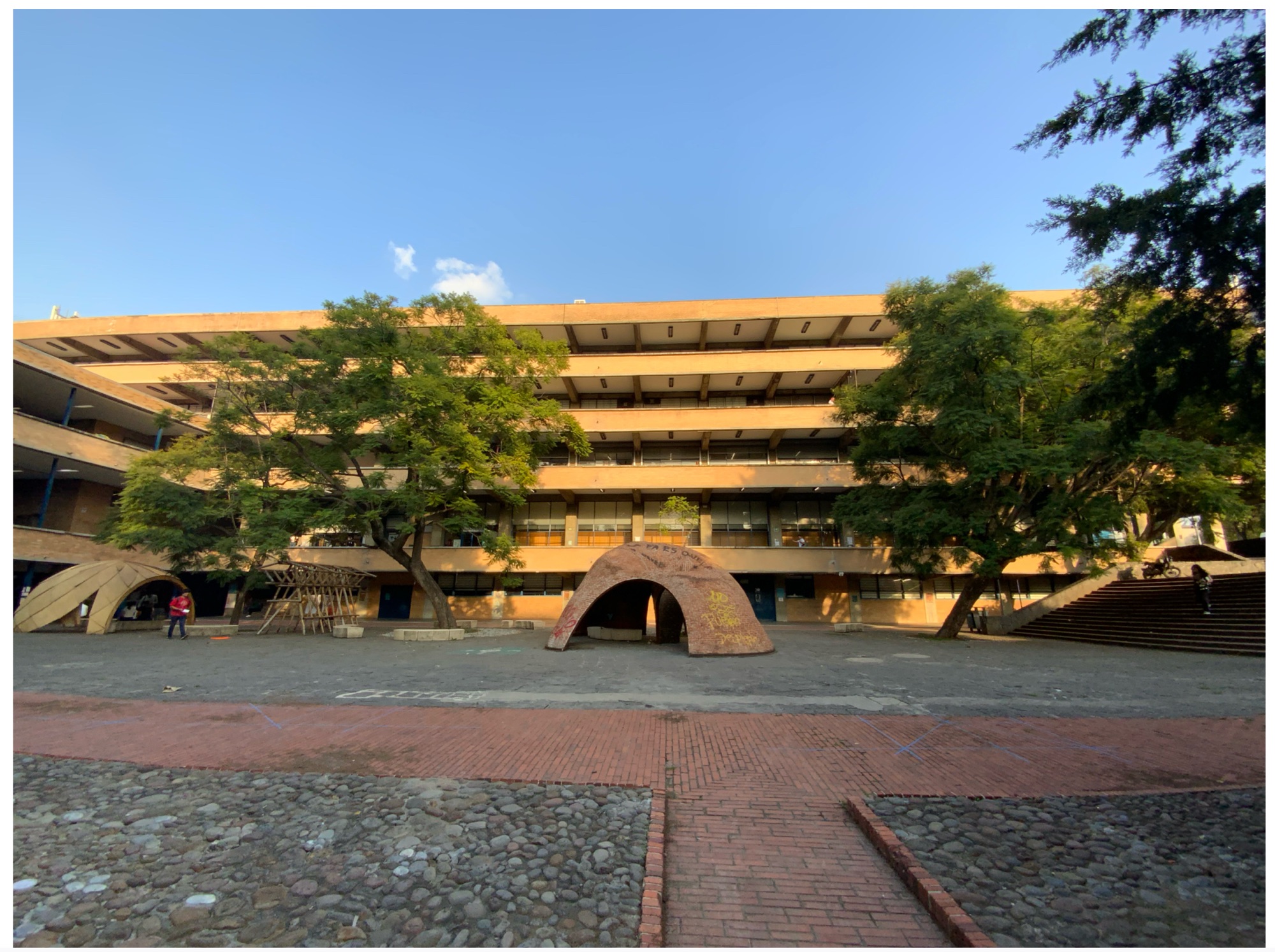
Aulas K is one example of a building that sits within the boundaries of UNESCO’s protected university campus at UNAM’s School of Architecture. Today, the 5-story building (8,500 square meters of built area) hosts 15 different functions, including classrooms, administration offices, research labs, and union offices. The paper explains the process of surveying the tectonic and thermal conditions of Aulas K, intending to reduce the internal temperature, increase the percentage of relative humidity, and reduce the energy consumption of the building.

The research responds to the following questions: a) How comfortable are the internal spaces, considering an east-west orientation in the two most prominent facades of the building, without a system of air conditioning or heating? b) How efficient is the electricity supply and consumption of the building? This work describes two intervention proposals. One offers a system of internal pivoting thermal panels in the east façade and cross ventilation solutions in the west façade of the classrooms and computer labs, which cover 63% of the total built area of the construction.
The second scheme is the projection of 400 photovoltaic panels on a 1,700 m2 roof for an independent supply of 250,000 kWh per year, encompassing 100% of the electrical demand by renewable energy. The passive and active thermal comfort and energy efficiency methods described in this paper seek solutions for adapting to climate emergencies and improving the quality of life of thousands of users in Ciudad Universitaria.

After a process of careful surveying the physical conditions of the construction, with a built area of 8,500 m2, we asked ourselves two questions:
1. How efficient is the electricity supply and consumption of the building?
2. How comfortable are the spaces, considering an east-west orientation in the two largest facades, without a system of air conditioning or heating?
We partnered with two institutions: the UNAM’s School of Engineering and the Environmental Programme Eco-Puma. The outcome was the release of the following three documents:
1. UNAM School of Engineering:
Document “ENERGY SAVINGS AND EFFICIENT USE IN BUILDINGS. ANALYSIS OF THE ‘K’ BUILDING AT THE SCHOOL OF ARCHITECTURE”
2. UNAM School of Engineering:
Document “TOPOGRAPHIC SURVEY AND ALTIMETRY USING DRONES AT THE FACULTY OF ARCHITECTURE”
3. UNAM Eco-Puma Environmental Distinction.
Document “UNAM ENVIRONMENTAL DIAGNOSIS, FACULTY OF ARCHITECTURE”


Once we reviewed and studied the findings and tools of the documents, we focused on two main solutions. We considered the feasibility and scale of the interventions in terms of time schedules (summer and winter breaks) that do not affect the terms of the School of Architecture. The proposals are:
1. Double façade in the classrooms and computer labs (63% of the total built area of the building): Interior pivoting thermal panels, along with cross ventilation through sliding windows facade that face the corridors.


2. 400 photovoltaic panels on a 1,700 m2 roof for independent supply of 250,000 kWh per year (100% renewable energy)

For this solution, we partnered with UNAM’s Institute of Renewable Energy and UNAM’s School of Engineering. Their guidance was important because we were able to calculate the projections of electrical supply and demand of the building. The return of investment after the installation of the 400 solar panels is 4.5 years. If the project starts in 2025, Aulas K would be energetically independent from the main electric grid by 2030.


Leave a Reply