
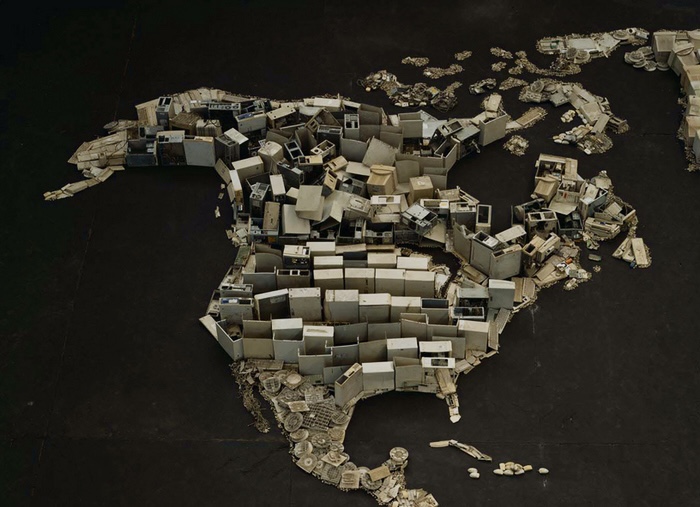
“Calling this place ‘America’ is to name it after a stranger. ‘Turtle Island’ is the name given this continent by Native American based on creation mythology. The United States, Canada, Mexico, are passing political entities; they have their legitimacies … but they will lose their mandate if they continue to abuse the land. The state is destroyed, but the mountains and rivers remain.”
Gary Snyder, 1990

The idea of North America as a united economic-political-environmental system that encompasses Canada, the USA, and Mexico is relatively new. It can be traced back to the late 19th century as the result of the rise of interconnected, industrialized economies and national states’ alliances.
During the 1980s, the intensification of this concept generated NAFTA (North American Free Trade Agreement, signed in 1992). The agreement was based on the dominant discourse at the time that called for free-market economic agglomerations.
John C. Super and Michael M. Brescia have noticed that in North America, with its many climatic and vegetation zones that stretch from the arctic north to the tropical south, space (in various scales and dimensions) assumes special importance in explaining the varieties of human experience. The boundaries that delineate each nation-state within North America are artificial creations that emerged in the nineteenth century. These borders, drawn and interpreted as they were by people of their time, illustrate in concrete fashion the political and diplomatic features of the North American past.[i]
At the beginning of the 21st century, the notion of North America is still mutating. In 2020 the United States-Mexico-Canada Agreement (USMCA) entered into force as a NAFTA 2.0. The landscapes of three main entities are fragmented (and sub-fragmented) in multiple regions (biodiversity), cities (the urban), and towns (the rural), that host a total population of almost 500 million people and a total economic output of around 23 trillion U.S. dollars. USMCA is one of the world’s largest free trade areas according to the World Bank.ii
This updated agreement includes ecological concerns and metrics of sustainability that, at least on paper, should be implemented by the three countries. For instance, the environment chapter of the USMCA brings environmental provisions into the core of the agreement and makes them enforceable. The USMCA includes commitments to implement key multilateral environmental agreements and engages the United States, Canada, and Mexico to take actions to combat and cooperate to prevent trafficking in timber, fish and other wildlife. For the first time in a U.S. trade agreement, the USMCA also addresses other pressing environmental issues such as air quality and marine litter.[i]
Energy and Cities in North America
The decoupling of energy demand and GDP growth is a prerequisite for a sustainable future in our cities. Since 1971, every 1% increase in global Gross Domestic Product (GDP) has been accompanied by a 0.6% increase in primary energy consumption. See the 5th Edition (2015) of the World Energy Scenario Energy [R]evolution. Meeting the energy needs of a growing population in an environmentally friendly manner is the fundamental challenge if we want to achieve a sustainable global energy supply.
We need to understand the dynamics of economic regions in the world in order to design and implement sustainable scenarios for energy transition in cities. For example, the energy system of the three members of the OECD (Organization for Economic Co-operation and Development) in North America (United States, Canada and Mexico) is dominated by the development of the United States, the country with more than 80 % of the region’s energy demand.
In the United States and Canada, reducing the energy demand through efficiency plays a crucial role in decarbonizing the OECD energy system in North America. In Mexico, on the other hand, the expectation of higher rates of investment in public infrastructure, along with population growth, will result in higher energy demand, despite ambitious plans to increase energy efficiency.
We are about to start the 2nd quarter of the 21st Century. In one of the most dynamic economic regions of the world, the ecological imagination of their cities and towns must be studied and implemented.
[i] North America: An Introduction. (2008) John C. Super and Michael M. Brescia. University of Toronto Press
[i] https://ustr.gov/trade-agreements/free-trade-agreements/united-states-mexico-canada-agreement/benefits-environment-united-states-mexico-canada-agreement


Leave a Reply